



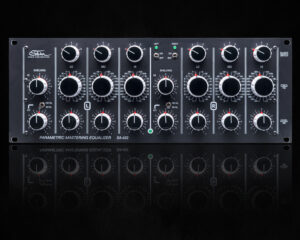
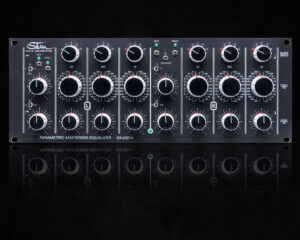

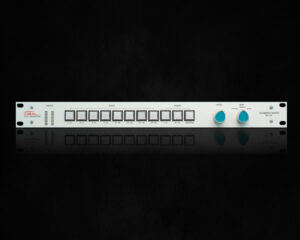


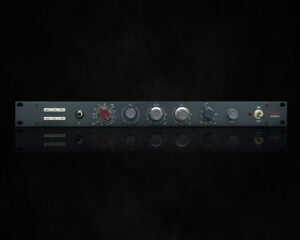
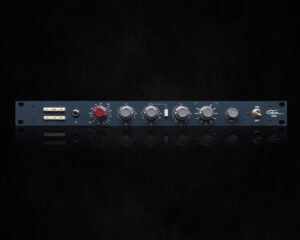
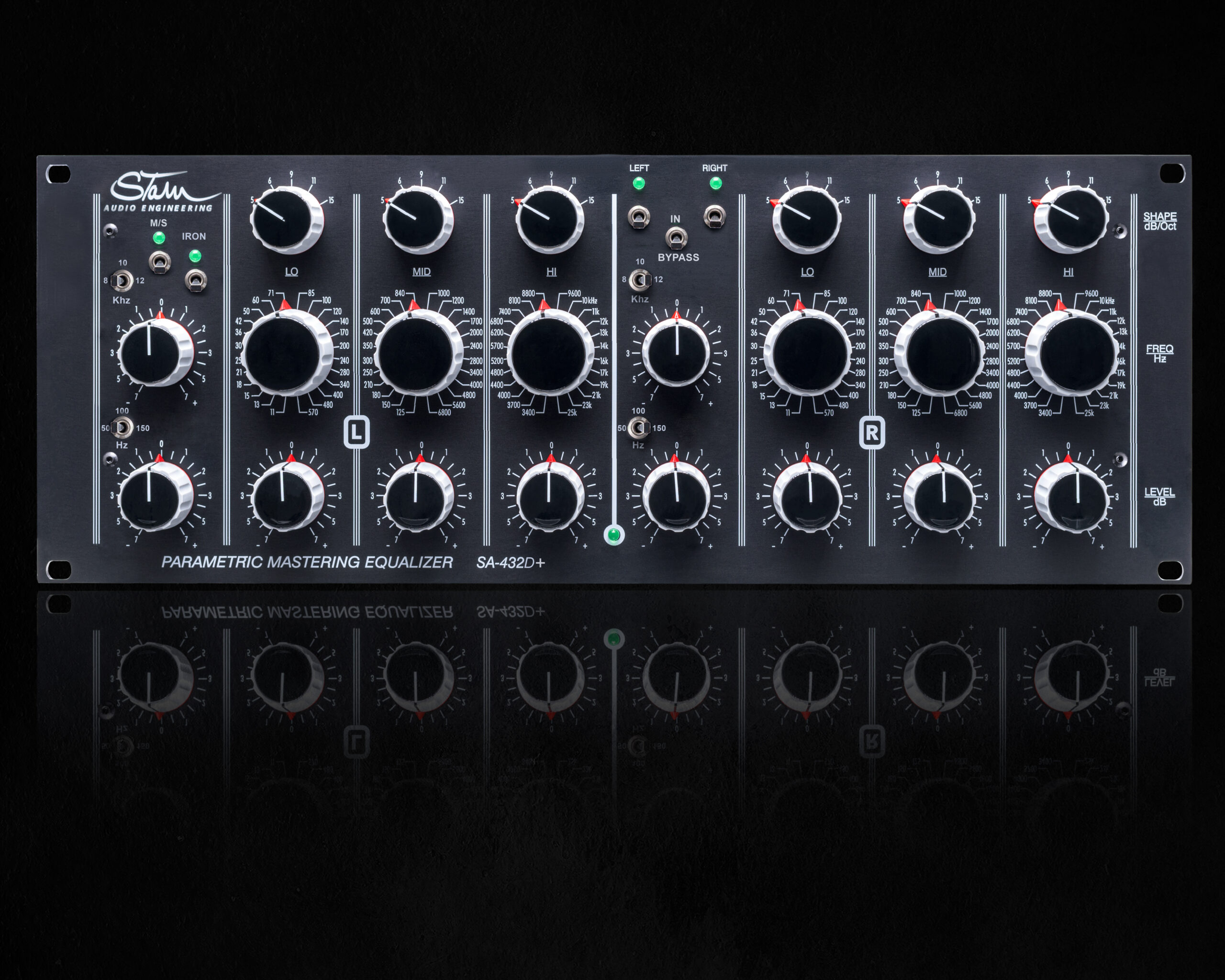
A 1:1 replica of iconic Sontec 432D9.
The Sontec MES-432 was one of the first fully parametric stereo studio equalizers built in the mid 70’s. With fully stepped switches, surgical precision and extremely musical op-amps, this EQ made its way on to virtually every single successful record in the 80’s and 90’s and it’s still used till this day as the go to equalizer for mastering engineers around the world.
Utilized by some of the most demanding engineers in the world, the Sontec MES-432D9D variant added a two position high shelfving frequency selector (8Khz and 12Khz) instead of the fixed 10kHz found on the C variant. In an attempt to give our customers something extra we added all three positions as well as adding a third position on the low shelf (150Hz) . The SA-432D+ comes with 8kHz, 10kHz and 12kHz on the high shelving and an extra 150Hz position on the low end frequency selector as well as the Iron Mod, Mid/Side and True Bypass included.
The Op-Amps
At the heart of every Sontec MES-432D you will find six HS2030 and six HS6000 discrete op-amps. No other op-amp sounds the same and no other op-amp should be used in this circuit. After 2 years of meticulous measurements, auditioning parts and listening tests we successfully reverse engineered these amplifiers which are fully compatible with the originals. The original DOA’s were famously known for being unreliable and unstable so we took this opportunity to improve the original design with better heat dissipation leaving them unpotted for more stability and longevity which was one of the main concerns with the original. Just like the original unit they run at +-28V for extended headroom and are fully discrete with 13 transistors in each op-amp. The SA-432 features a total of six reverse engineered HS2030 and six HS6000 per unit.
The Circuit
Utilizing the original DOA’s plus respecting the original schematic and circuit allowed us to bring this legendary unit back to life in a stable and faithful way. The Q has been respected and is 100% faithful to the original. Fully stepped switches with 1% tolerance resistors have been implemented for perfect and surgical stereo matching and easy recallability. With its 0.5 dB steps for the first 3 dBs, it is perfectly suited for mastering work. The three parametric bands offer wide, overlapping frequency ranges for musical tone shaping.
The filter design is a Bridged-T-filter in the feedback loop of an op-amp. If you enable the bypass only the filter section is bypassed. The amp section with its HS2030 opamps is still active, just like in the original.
Added Features
The SA-432D+ comes with the following added features:
- Mid/Side operation
- Switchable transformers (Iron Mod)
- Addional low shelf (150Hz) frequency selector
- Additional 10kHz high shelving frequency selector
- True Bypass on faceplate
Superior Components
Each SA-432 comes with state-of-the-art power supply to ensure complete silent operation with Panasonic capacitors. Each band uses 1% tolerance resistors and matched WIMA MPK and Polystyrene capacitors as well as Neutrik XLR connectors have been implemented with period-correct knobs.
100% satisfaction guarantee – if you don’t love your SA-432D+, we’ll refund you
If you’ve used an original Sontec 432D9 before, we’re extremely confident the Stam Audio SA-432D+ will put a big smile on your face every time you use it. However, if you’ve never touched the original before, as gear-lovers ourselves, we understand that the only way to really know if this compressor is for you, is to put it through its paces. That’s why the SA-432 comes with a 30 day money back guarantee. This allows you to get it into your rack and see how it impacts your recordings. If you love it (and we think you will!), great…keep the unit and create amazing music with it. If not, no problems. Just send it back to us and we’ll fully refund your purchase.
Brian Murphree –
When it comes to mastering-grade EQs, the 432 is often lauded as the “holy grail” of equalizers. Even so, many old 432 EQs in the industry, if they’re not cemented in the hands of notable mastering engineers, they’re often sold at esoteric prices, even though they are noted for being unstable, inconsistent, and unreliable. In fact, many old original Sontec EQs have been gutted and are in fact now clones of themselves. You’d be hard pressed to find a true original in superb shape.
Stam has done a tremendous job here creating a 1:1 replica of the old Sontec, and adding features some original owners might consider selling their EQs to acquire. M/S, selectable transformers, true bypass, additional high and low shelf frequencies—what’s not to like?
With some comparisons, I can say this: While many other EQs may sound great, and even venerable modeled plug-ins bearing the Sontec name or perhaps a suspiciously-looking likeness, all of them I’ve tried are not the same. But here’s how they compare. Most plug-ins seem to “glue” or compress/flatten the sound, where the Stam 432D allows the soundstage and depth to remain separated. It doesn’t glue the components together. It maintains every bit of depth, width, and size of the original mix. One of the crown jewels of the Stam 432D is in the deep bass and extreme highs. I don’t have another analog EQ that can match the quality and performance of this EQ.
The Q on each of the three main bands “seems” narrow to me for mastering, but tastefully so. I’d assume these are exactly the same as the vintage units, and they work perfectly.
I also love the +/- 7 dB of boost and cut on the main three bands. Noting they are not linear (smaller steps of 0.5dB with smaller adjustments) is profound for mastering duties. The IRON option is subtle, but appropriate. Bass reaches down into the lowest fundamentals with ease, and the 25kHz boosted to the max provides some beautiful “Air”. Midrange is clear and consistent. I didn’t find any faults here. It’s clean. I find using a “dirty” EQ for boosting mids works for me, but the 432D is no wimp when it comes to this area, either! It handles everything without rudeness.
If you could only buy one EQ for mastering, this is the best start. You’d only need some sterile mathematical plug-in EQs for anything else.
Was it worth the wait? Yes.
Would I buy another? Yes.
Did Stam Audio knock this design out of the park? You bet!
Pining for an old Sontec 432? Stop shopping and buy this!